MALEFACTOR
Analog behavior. Digital control. Violent by design.
Malefactor is a semi-modular virtual-analog synth modelled in volts. Every stage has its own headroom and its own way of clipping. The shape knob changes the level, the mixer has no makeup gain, resonance fights the oscillators for headroom, the cutoff sits behind a vactrol that opens fast and closes slow, and the amp's control inputs rectify. Turning something up changes what it sounds like, not just how loud.
Patch it like hardware: 32 bipolar cables, audio signals as modulation sources, and factory normals you can patch over. Draw your own envelopes, loop them as sequencers, add chaos and hum, play it mono or duo, and add Unison up to four voices wide.
Buy it once, own it forever. Fully offline after a one-time activation. No subscription, no account.
One-time purchase
$59
Coming soonBe notified when Malefactor is out. Drop your email and we'll let you know the moment it's available — no spam, just the launch.
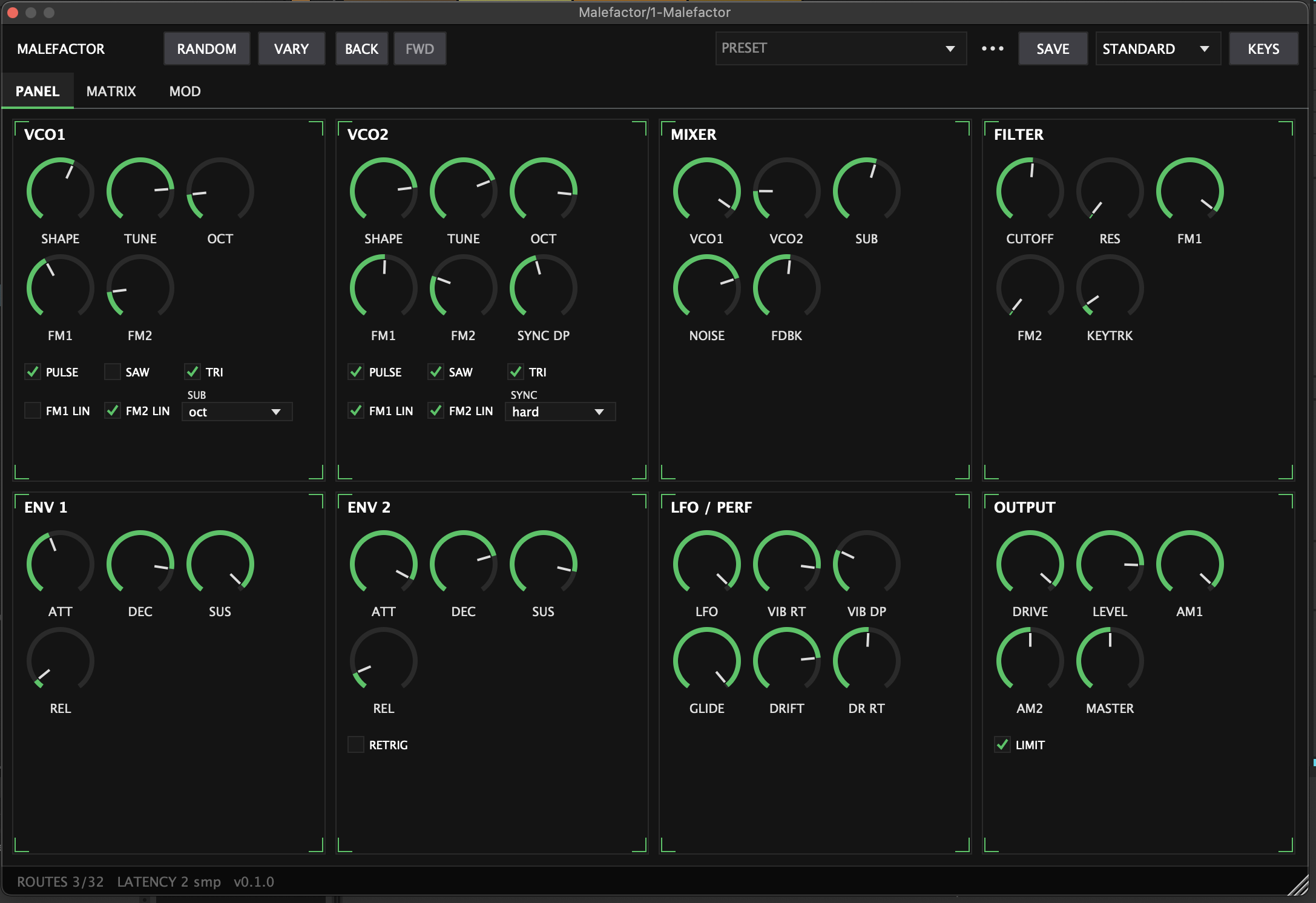
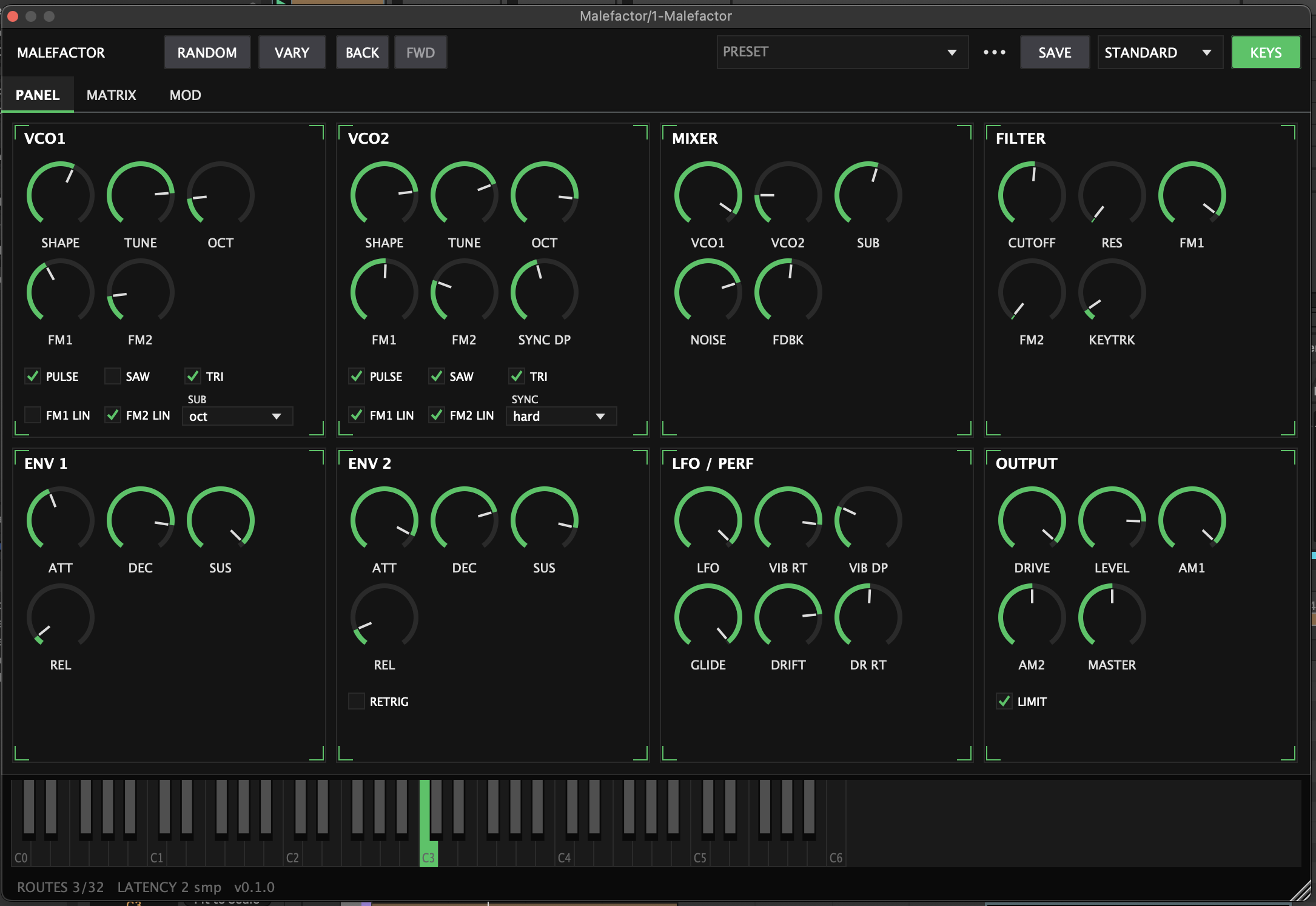
- Two Analog-style VCOs with through-zero linear FM, hard/soft sync, sub oscillator, and noise
- Saturating mixer with no makeup gain and a built-in feedback return
- Nonlinear multi-input state-variable filter behind a vactrol model. Self-oscillates, tracks, and gets eaten by level
- Differential-pair VCA with two rectifying AM inputs and 12× drive
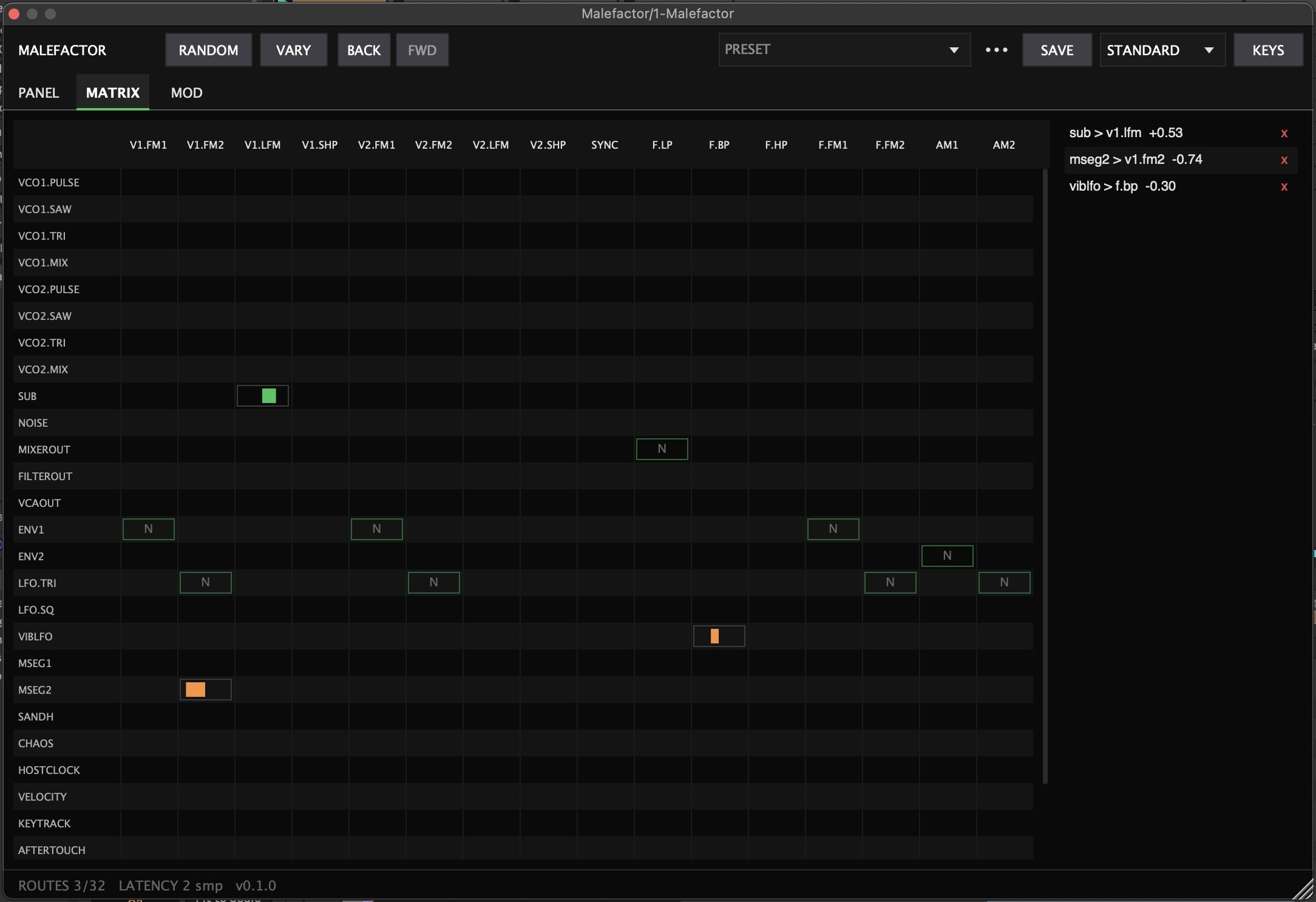
- 32-route bipolar modulation matrix with audio-rate sources and factory normals
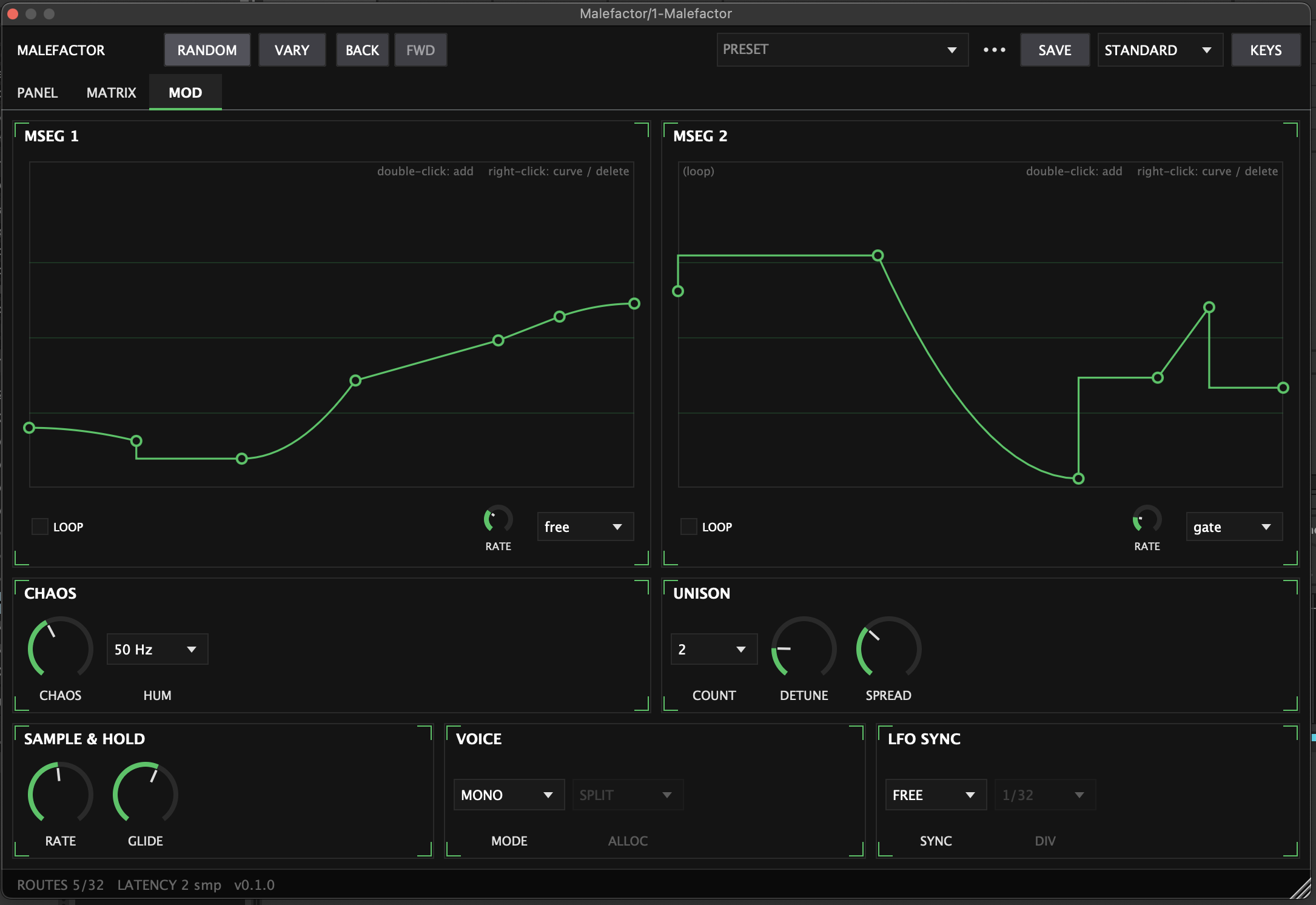
- Two drawable MSEG envelopes (free / gate / loop), host-syncable LFO, sample & hold, chaos, hum, and drift
- Mono and Duo voice modes (last-two or split allocation), plus unison up to 4 voices with detune and spread
- Random and Vary patch generators, Back/Forward patch history, file-based presets, MIDI learn
- Standard and Insane quality modes; bounces always render at Insane with 2-sample latency
- VST3 and AU on macOS, VST3 on Windows and Linux
- Perpetual license. Buy once, fully offline after one-time activation
MODELLED IN VOLTS
Most virtual-analog synths normalize every stage so nothing ever clips by accident. I built Malefactor the other way round. Each stage has its own headroom and its own way of running out of it. These are the five places you'll hear it.
The shape knob changes the level, not just the tone.
Two chip-style oscillators where pulse, saw and triangle all come off one core. Pulse width changes loudness the way it does on the hardware, two tear zones latch mid-travel, and linear FM runs through zero, so a hard enough modulator runs the oscillator backward.
Nothing turns the others down.
Six inputs into one summing node with no makeup gain. Stack VCO1, VCO2 and the sub and the mix clips harder instead of auto-balancing; pull one out and the rest clean up. The last quarter of every level knob is where it runs out of headroom, and a feedback return brings the output back in for growl without any external routing.
Past about 45%, the filter plays itself.
A nonlinear state-variable filter solved inside every sample. Resonance goes negative and self-oscillates from silence with the same attack on every note, and it tracks the keyboard. The resonance path has a small headroom limit, so bring an oscillator in loud and the ring collapses. That's not a bug; it's how a real filter behaves.
Fast to open, slow to close.
Cutoff sits behind a vactrol model. A symmetric LFO goes in and a lopsided wobble comes out, because the opening edge is quick and the closing edge lags. Push audio-rate filter FM through it and the sweep tilts into a vowel. Lowpass, bandpass and highpass are separate outputs you mix, not a mode switch.
It never goes negative. It goes metallic.
A differential-pair VCA with two AM inputs that rectify. A slow LFO on AM2 only ever boosts over a held envelope, so you get tremolo that gets louder and, with the other input, tremolo that pumps to silence. At audio rate the rectifying input adds sidebands a ring modulator doesn't have. After that, a 12× drive into the hardest clip in the voice.
PATCH IT LIKE HARDWARE
32 cables. The factory patch is already on the grid.
The Matrix page is a 32-route modulation grid. Every cable is bipolar, and audio signals are modulation sources. Patch the sub into an oscillator's FM input and you have audio-rate FM without a third oscillator.
Patch over a normal and the knob steps aside.
The panel's default routings are factory normals, the same as the jacks on a semi-modular. Run a cable into a normalled input and that cable replaces it; delete the route and the panel knob is back in charge.
Envelopes you draw.
Two multi-segment envelopes with free, gate and loop modes. Loop one and it's a step sequencer; free-run it and it's a one-shot you can shape by hand.
Patches that never sit still.
A host-syncable LFO, sample and hold, a chaos source, mains hum and oscillator drift. Small amounts of any of them keep a held note moving the way hardware does.
Mono, Duo, or four voices wide.
Mono for bass. Duo gives two voices with last-two or split allocation, so one hand can hold a bass while the other plays a lead. Unison stacks up to four voices with detune and spread.
Random, Vary, Back, Forward.
Random builds a whole patch. Vary nudges the one you have. Back and Forward step through everything you did. Right-click any knob for MIDI learn.
WHAT IT ISN'T
So you don't buy it for the wrong job.
- It isn't polyphonic yet. Today it plays Mono or Duo, plus unison up to four stacked voices. I'm looking at full polyphony for a later update and won't promise a date.
- It isn't a pad synth. Two voices and a filter that fights back make bass, leads, drones and percussion. Lush eight-note chords are someone else's instrument.
- It isn't a preset browser for clean bread-and-butter sounds. If you want a VA that stays polite at every setting, most of them do that already and do it well.
- It isn't a wavetable or feature-list synth. Two oscillators, one filter, one amp, 32 cables. The depth is in how the stages misbehave, not in how many there are.
THINGS THAT LOOK LIKE BUGS
They aren't. They're the model doing what the circuit does.
The resonance drops when I turn an oscillator up.
On purpose. The resonance path has a small headroom limit, so loud input eats it. Use the mixer level to duck resonance instead of automating the resonance knob.
The shape knob changes the volume.
The three waveforms come off one oscillator core, and pulse width changes level on the hardware this is modelled on. I didn't normalize it; that's part of the sound.
A panel knob stopped working.
You patched a cable over its factory normal on the Matrix page. Delete the route and the knob comes back.
The bounce sounds different from the session.
It shouldn't. Bounces always render at Insane quality, whatever you were tracking at. If you hear a difference, tell me and send the project.
The LFO wobble is lopsided.
That's the vactrol model in front of the cutoff. It opens fast and closes slow. Patch the LFO straight into a filter input on the Matrix page if you want it symmetric.
Does it phone home?
Once, to activate. After that it runs fully offline. No account, no subscription.
FORMATS & HOSTS
Malefactor is a plug-in instrument, not a standalone app, so you need a DAW or plug-in host. Ableton Live 12 is the reference host I develop and test in; the builds are also validated with Apple's auval and with pluginval. If your host does something odd, tell me which one.
SPECIFICATIONS
The plain facts, in one list.
- Type
- Semi-modular virtual-analog synthesizer plug-in. Each stage modelled in volts with its own headroom and clipping.
- Formats
- VST3 and AU on macOS. VST3 on Windows and Linux. No standalone.
- Oscillators
- Two chip-style VCOs (pulse, saw, triangle off one core) with through-zero linear FM, hard and soft sync, plus a sub oscillator and noise.
- Mixer
- Six inputs into one saturating summing node, no makeup gain, built-in feedback return.
- Filter
- Nonlinear multi-input state-variable filter solved per sample; lowpass, bandpass and highpass as separate mixable outputs; self-oscillates and tracks; cutoff behind a vactrol model.
- Amp
- Differential-pair VCA with two rectifying AM inputs and a 12× drive stage.
- Modulation matrix
- 32 bipolar routes. Audio signals usable as sources. Factory normals that a patched cable replaces.
- Modulators
- Two drawable multi-segment envelopes (free, gate, loop), host-syncable LFO, sample and hold, chaos, mains hum, drift.
- Voices
- Mono; Duo with last-two or split allocation; unison up to 4 voices with detune and spread. Not polyphonic.
- Quality & latency
- Standard quality for tracking, Insane for bounces; renders always use Insane. 2 samples of latency.
- Presets
- Plain
.mfpresetfiles in your Documents folder. Back them up or share them like any other file. Random and Vary generators, Back/Forward patch history. - MIDI
- MIDI learn on every knob via right-click.
- License
- One-time purchase, perpetual license. No subscription.
- Activation
- Internet needed once to activate. Fully offline after that. No account needed to run the plug-in.
- Refunds
- Full refund within 14 days of purchase. Refund policy.
HOW IT WORKS
Instant Download
Download your software and license file immediately after purchase. No waiting. No approval queue.
Yours Forever
One-time purchase. No subscriptions. Fully offline after initial activation. Your license never expires.
Direct Support
Support direct from the developer. Not a ticket system. Easy bug reporting through GitHub.